ASPACE-Q 

The Astrophysics,  Space  Exploration and Quantum Computing Group   

 ASPACE-Q 

The Astrophysics,  Space  Exploration and Quantum Computing Group   

by Maria Ișfan, PhD student 

08.01.2025


Quantum internet is one step closer to becoming reality! A group of scientists from USA achieved the first teleportation of a photon through an operational optical fiber, as reported in their paper published in journal Optica. In other words, alongside the transmission of classical data, the scientists also managed to transmit quantum data!

Quantum teleportation is a process that can be demonstrated in the laboratory. It is one of the cornerstones of quantum networks, which are far more secure than their classical counterparts. It involves transferring the state of one quantum particle (in this case, a photon) to another quantum particle. This state represents quantum information, or data. The first photon contains the data to be teleported, while a second photon, the receiver, is located over 30 km away. The two photons are connected through a telecommunications optical fiber cable, which transmits classical data in the frequency band of 3.7 GHz - 4.2 GHz at a speed of 400 Gb per second. The teleportation of the first photon's state to the second photon was achieved simultaneously with the transmission of classical data. In essence, a photon was teleported from one end of the operational optical fiber to the other, without losing the data it carried.

The success of this teleportation demonstrates the feasibility of quantum networks and opens new perspectives for the practical realisation of quantum telecommunications: from teleporting multiple photons through optical fibers transmitting data a thousand times faster to the realization of the quantum internet. 

SOURCE: Quantum teleportation coexisting with classical communications in optical fiber

quantuminternetalliance.org 

by Laurențiu Caramete, PhD

23.12.2024


‍In recent years, observatories such as the Zwicky Transient Facility (ZTF) have begun continuously scanning the sky. This means astronomers can collect “light curves”—records of how an object’s brightness changes over time—for thousands of cosmic objects on an almost daily basis.


‍Among the studied objects is AT 2021hdr, which initially seemed quite ordinary. Its brightness in the optical band resembled that of a classic Seyfert 1 galaxy—a well-known active galactic nucleus (AGN) recognized for its bright central region powered by a supermassive black hole. Observations at both visible (optical) wavelengths and higher-energy X-ray bands appeared to confirm this usual classification.


‍However, at the end of 2021, astronomers observed that AT 2021hdr began to exhibit sudden episodes of increased brightness—peaks that appeared and disappeared in a predictable pattern. Instead of a single outburst, these short bursts recurred every 60 to 90 days, each time producing an increase of about 0.2 magnitudes in the optical g and r bands. Similar oscillations were also seen in ultraviolet and X-ray data from NASA’s Swift observatory.


‍Several explanations were proposed—standard tidal disruption events (TDEs), binary supermassive black hole (BSMBH) systems, and “changing-look” AGNs—but none convincingly account for the details observed in AT 2021hdr. For example, a typical TDE happens when a star comes too close to a single supermassive black hole and is torn apart, generating a bright flare that eventually fades. In contrast, AT 2021hdr shows repeated outbursts, not a single episode of brightening followed by dimming.


‍It also does not match the signatures of previously observed binary supermassive black holes or the well-documented phenomenon of “changing-look” AGNs, in which a galaxy’s core abruptly shifts from one spectral state to another. Radio observations from the Very Long Baseline Array (VLBA) did not provide a signal on the milliarcsecond scale, which argues against jet-related scenarios. The pattern of eruptions and their amplitude also appear inconsistent with typical disk or jet instabilities.


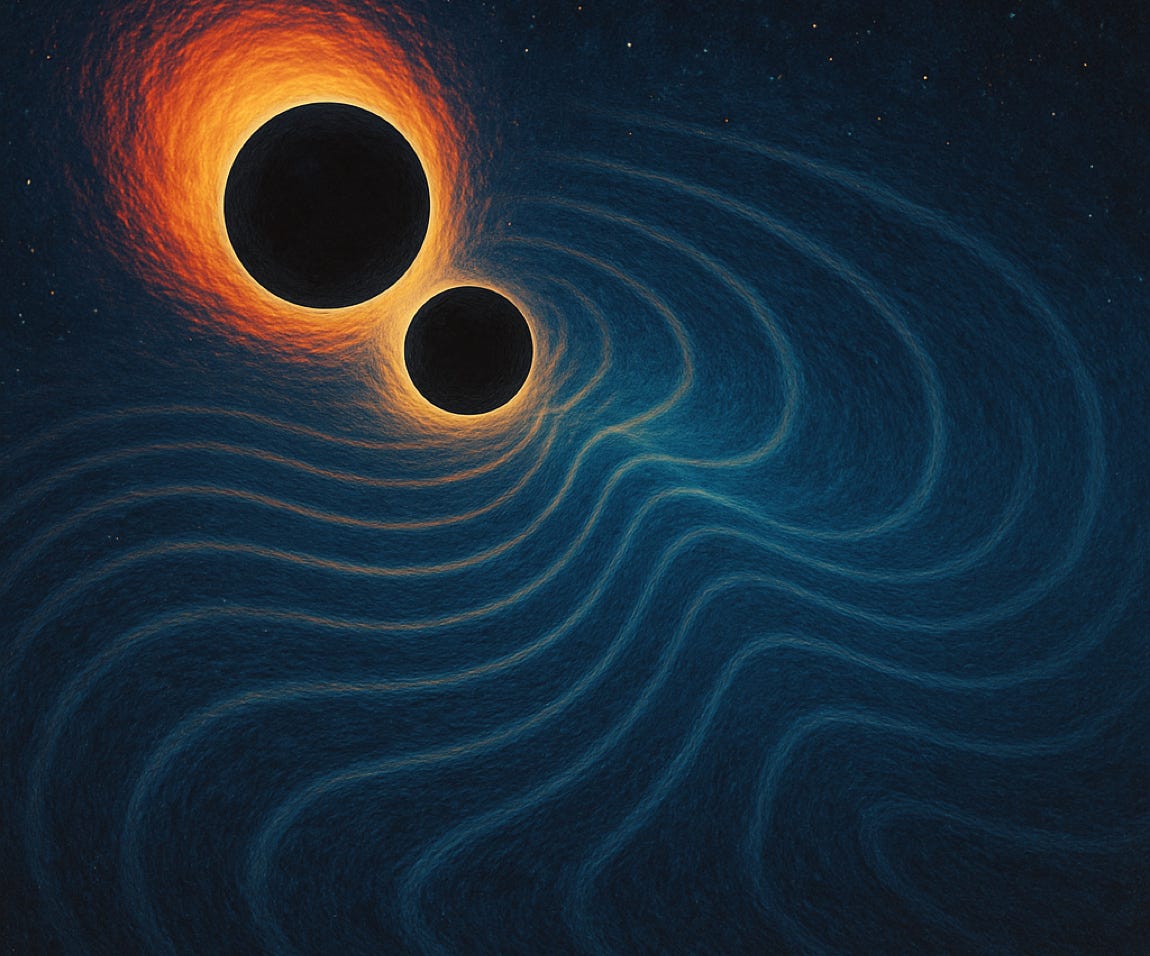
‍In a new study, researchers propose that a binary supermassive black hole system—two black holes orbiting one another in the heart of the same galaxy—could be shredding a cloud of gas, rather than a single star. The gravitational dance of the black holes in this configuration could lead to repeated episodes of increased brightness, as the displaced gas interacts with the system.


‍Based on the observed outbursts, the study estimates that the separation between the two black holes is about 0.83 milliparsecs (mpc). On cosmic timescales, this pair would merge in a relatively short period of about 70,000 years, although for humans that is still extraordinarily long.


‍As if the scenario were not already complex enough, the galaxy hosting AT 2021hdr lies only 9 kiloparsecs from a companion galaxy—a distance that suggests the two galaxies might also merge. This two-galaxy system was reported recently, but the authors emphasize that the companion galaxy is unlikely to be responsible for the eruptive behavior of AT 2021hdr.


‍If confirmed, the tidal destruction of a gas cloud by a binary black hole would offer a rare opportunity to study the final stages of black hole mergers.

by Răzvan Balașov, PhD

14.12.2024

A new observational study hints at how big (from a mass point of view) can black holes grow. This is the

latest of several attempts during the past (ref 1, ref 2, ref 3)

The current paradigm is that a category of these objects (massive and supermassive ones) lies in the

centers of galaxies. Observations and estimations place the most massive of them at mass values of tens

or even a hundred billion solar masses. Therefore, a new keyword was introduced: ultramassive

(simplified as UMBH or UBH), for massive black holes that exceed 10 billion solar masses - although the

value is still disputed. For reference, massive black holes (MBHs) start somewhere at tens of thousands

of solar masses and supermassive ones (SMBHs) at hundreds of thousands.


A popular method to determine the mass of a black hole is to link it to the stellar mass of their host

galaxies (scaling relations). These correlations also suggest that there is a tight connection between the

formation of stars and central black hole growth. Thus, the higher the stellar mass of a galaxy, the

“bigger” the black hole can get.

A team led by Priyamvada Natarajan from the Department of Astronomy at Yale University suggests that

there should be a limit for this growth and that limit is imposed by the black hole itself. Considering that

black holes cannot accrete the entire available material that surrounds them and that this material has

to be relatively close to the object, a few growth-related difficulties pop into discussion.

Firstly, massive black holes generate astrophysical jets of particles from the gas, dust, and stars that is

not accreted. This action prevents star formation around the central black hole (gas and dust need to

clump together in order to form stars and that can happen only if they cool down).

Secondly, this generation of particle jets also pushes the available gas that was near the black hole (the

central region of the galaxy). And, once this central region material is consumed, the black hole growth

stops.

Considering these factors, Natarajan places the upper mass limit around 100 billion solar masses.

Momentarily, this statement is supported by their latest finding, Phoenix A, which lies approximately at

that value limit. You can check out the following figure for more details on the observed and predicted

black hole mass depending on the different efficiencies (epsilon) with which the black hole accretes

material:


The team's research is published on the scientific preprint repository site arXiv.

by Ana Caramete, PhD

05.12.2024


                Image credit: Ben Yuen and Angela Demetriadou


In an article published in mid-November in Physical Review Letters, two researchers from the School of Physics and Astronomy at the University of Birmingham described a new way to characterize the properties of a photon in a given medium, simplifying the mathematics underlying the theory.


Because the properties of photons are heavily dependent on the environment  in which they propagate, the mathematics describing them is extremely complex and involves solving an enormous number of equations to obtain an answer.


The two authors found a way to simplify these calculations, and the formalism they developed made it possible to model the properties of a photon emitted from the surface of a nanoparticle (a particle with dimensions 1,000,000,000 times smaller than 1 meter), to describe its interactions with the emitting source, and to understand how the photon propagated away from the source.


Finally, it became possible, for the first time, to generate an image of a photon, which turned out to be a particle shaped like a lemon.


However, the authors emphasized that this shape is valid only for a photon generated under these specific conditions and that it changes completely in a different environment due to the photon's dual nature, as both particle and wave. Thus, the wave stretches or shrinks, bends, slows down—in other words, it takes on a different shape depending on the environment through which it propagates, much like a dancer adapting their movements and body shape to the stage and the music they are performing to.


And, as the saying goes, “when life gives you (photon)-lemons…” 😊. The formalism developed by the team of researchers from Birmingham opens up a new universe of possibilities for photon exploitation: new ways of capturing light and developing innovative photovoltaic devices, a better understanding of photosynthesis and the creation of artificial photosynthesis, quantum communication, and many other applications yet to be imagined.

by Răzvan Balașov, PhD & Florentina Pîslan, PhD student

21.11.2024

‍Researchers from Durham University have developed a model to estimate the chances of intelligent life emerging in different universes, focusing on the effects of dark energy and star formation rates. 

‍Despite its name, the dark energy is not actually as “dark” as it sounds :) It is only called like this because we can not actually “see” it and know how it works, yet we do know that it represeents that one secret ingredient needed for explaining the accelerated expansion of the Universe. 

‍The article published in Monthly Notices of the Royal Astronomical Society highlights how our universe’s conditions for life may be rare, yet similar life-friendly conditions might exist even in universes with higher dark energy densities. This work updates theories like the Drake Equation, combining simulations and theoretical frameworks to explore the delicate balance required for life. 


‍                    The Drake Equation


‍According to the Royal Astronomical Society, the equation dr. Drake came up with could give a rough estimation of  “detectable extraterrestrial civilizations in our Milky Way galaxy”.  In order to do so, the formula takes into account the number of stars that are freshly born in the Milky Way each year,  how many stars have planets orbit them as well as the number of worlds that have the potential of supporting life.


‍.


‍Compared to the initial equation, the newly developed model also considers the effect of dark energy density.

‍Terms of Drake equation explained

‍Credit: https://ras.ac.uk

How the same region of the Universe would look in terms of the amount of stars for different values of the dark energy density. Clockwise, from top left, no dark energy, same dark energy density as in our Universe, 30 and 10 times the dark energy density in our Universe. The images are generated from a suite of cosmological simulations.

Credit: Oscar Veenema

Contact us at:

 iss dash sci at spacescience dot ro