ASPACE-Q 

The Astrophysics,  Space  Exploration and Quantum Computing Group   

 ASPACE-Q 

The Astrophysics,  Space  Exploration and Quantum Computing Group   

by Răzvan Balașov, PhD

31.01.2025

Image credit: Shutterstock


A recent study from Duke University has added new information to the ongoing question regarding the Universe's expansion, often referred to as the "Hubble tension." This issue arises from a discrepancy that scientists measuring the Universe’s expansion rate (the Hubble constant) are getting. There are different results depending on the method used. The new findings suggest that our current understanding of cosmology may need adjustments to account for a faster-than-expected expansion.

To calculate the Hubble constant, astronomers rely on a method called the cosmic distance ladder, which means various techniques are used to determine how far away celestial objects are. In this study, researchers used data from the Dark Energy Spectroscopic Instrument (DESI), which collects observations of over 100,000 galaxies every night. 


(Left) The locations of the SNe Ia identified to be in the Coma cluster (yellow stars) and the galaxies identified to be in the Coma group as from the full S24Coma group catalog (light gray circles), the S24FP sample (dark blue circles), and the T15Coma group catalog (light blue circles). The center of the cluster is marked in red. The positions of the SNe are listed in Table1. (Right) For the rectangular box on the left, a colored image of that sky area with the SNe within that location marked (Credit: D. Scolnic et al. 2025, The Hubble Tension in Our Own Backyard: DESI and the Nearness of the Coma Cluster, ApJL979L9).


A key part of their approach involved accurately measuring the distance to the Coma Cluster, a massive collection of galaxies about 320 million light-years away. They accomplished this by analyzing the brightness patterns of 12 Type Ia supernovae—exploding stars that have a well-known characteristic named luminosity, making them useful for measuring cosmic distances.

The researchers determined a Hubble constant value of 76.5 kilometers per second per megaparsec. This value aligns with other recent measurements of the nearby Universe but remains at a stanstill with predictions based on observations of the more distant cosmos. Lead author Dan Scolnic pointed out that this growing inconsistency may indicate deeper issues with the standard cosmological model. Therefore, the study also highlights the need for a fresh look at current theories to resolve the contradictions in our understanding of how fast the Universe is expanding.

by Alice Păun, PhD student

24.01.2025

ANITA (ANtarctic Impulsive Transient Antenna) is an instrument mounted on a hot-air balloon, optimized to detect polarized radio emissions originating from the electromagnetic component of cosmic ray cascades formed in the atmosphere. ANITA can detect these emissions either reflected off the surface of glaciers or directly, without reflection, from descending events near the horizon. These two types of signals can be easily distinguished due to the phase inversion that occurs when the wave is reflected. Two of the experiment’s flights, ANITA-I and ANITA-III, detected two unusual upward-going events (27.4° and 35° below the horizon) that behave like direct signals, even though they reach the detector at angles typical of reflected signals.

Starting from a 2016 article by the ANITA Collaboration, the observation of these unusual events and the vague explanations regarding their origins led to highly creative but incorrect interpretations by journalists, causing confusion among the general public. Most media reports claimed that researchers had uncovered evidence of an anti-Universe, a parallel universe identical to ours, where time flows backward, and the Big Bang marks its end, not its beginning, as in our universe.

Following this discovery, the scientific community proposed various scenarios, both within the Standard Model (SM) and beyond (BSM), to interpret these high-energy upward-going signals. One of the most promising SM strategies involves neutrinos passing “tangentially” through the Earth (traversing a shorter distance through the planet before exiting), producing electrically charged leptons that lose minimal energy before initiating the particle cascades observed by ANITA. The particle most likely fitting this model is the tau neutrino (ντ), which produces τ leptons through interactions with nucleons. Given the high energies of the two observed events, focusing on tangential neutrinos is explained by the fact that as neutrino energy increases, so does their interaction cross-section (probability of interaction with matter). For energies above 10⁸ GeV, the Earth becomes opaque to neutrinos [Ref1]. While neutrinos are often dubbed the “ghost particles” of the universe due to their near-zero mass and weak interactions, allowing them to travel vast distances unimpeded, at very high energies, their probability of interacting increases, making them more likely to reveal themselves.

Researchers also explored more daring scenarios involving beyond-the-standard-model (BSM) interpretations of these two atypical signals. Proposed models focusing on BSM particles fall into three main categories:

1.    Astrophysical neutrinos interact within the Earth and are converted into BSM particles that propagate through matter and eventually reconvert into SM particles capable of initiating electromagnetic cascades like those observed by ANITA. (https://arxiv.org/abs/1809.09615)

2.    Dark Matter accumulated inside the Earth decays, generating BSM particles that convert into SM particles near the glacier surface, inducing upward-going electromagnetic cascades.

3.    Sterile neutrinos, potentially arising from Dark Matter decay, travel long distances through the Earth, producing τ leptons via interactions with nucleons near the Earth’s surface, which then generate electromagnetic cascades. (https://arxiv.org/abs/1803.11554 , https://doi.org/10.1103/PhysRevD.99.095014)


Up to now, researchers have not provided definitive evidence for any scenario that explains these two high-energy upward-going events within the constraints of the Standard Model. Although none of the proposed BSM scenarios have been confirmed, such a discovery could have significant implications for fundamental physics, potentially bringing us closer to understanding Dark Matter, which, together with Dark Energy, constitutes approximately 95% of the universe, leaving only 5% as ordinary matter. Thus, while no solid explanation for these anomalies exists yet, the purported evidence of a parallel universe remains far from a valid solution to this puzzle.

by Florentina Pîslan, PhD student 

17.01.2025

Credit image: NASA, APL, SwRI


A recent study published in Nature Geoscience introduces a new theory for how Pluto and its largest moon, Charon, came to be a binary system. Instead of the traditional view that Charon formed from a massive collision, much like Earth’s Moon, researchers propose a gentler, more complex process they call "kiss and capture." This fresh perspective offers new insights into the dynamics of planetary formation in the distant Kuiper Belt. 


For decades, scientists have believed that Pluto and Charon were created through a high-energy impact, where a proto-Charon slammed into Pluto, ejecting material that later coalesced into the moon. However, this theory has some major challenges, particularly because Pluto and Charon are icy worlds, not molten planets like early Earth. A high-speed collision would likely have destroyed them or led to significant mixing of their interiors, which doesn’t match what we see today. 


To investigate a more plausible scenario, researchers from the University of Arizona ran sophisticated computer simulations that factored in the strength of ice and rock—something previous models often overlooked. Their findings suggest that instead of a violent smash, the two bodies initially stuck together in a "snowman-like" shape. For a brief time, they rotated as a single entity before gently pulling apart due to tidal forces, eventually settling into the stable binary system we see today. This "kiss and capture" model not only explains how Pluto and Charon managed to remain largely intact after their encounter, but it also has important implications for Pluto’s internal structure. As Pluto and Charon inched apart, the process probably produced heat through tidal friction — enough  to have kept almost all of an underground ocean from freezing. This is an exciting possibility: Pluto may  still have liquid water rezoning beneath its icy surface. If true, it could be a key clue  in the search for habitable environments in the far reaches of our solar system. 


But the implications  don't end there, this study also provides new insights as to how other binary systems in the Kuiper  Belt may have formed. Many icy bodies in this distant region exist in pairs, and the "kiss and capture" process might help explain their origins as well. This new view of Pluto and Charon’s past is complex and surprising, illustrating the complex planetary  evolution of the Solar System's frozen frontier. And so, rather than a destructive collision, their story may have been one of a cosmic embrace that shaped the worlds we see today.

by Maria Ișfan, PhD student 

08.01.2025


Quantum internet is one step closer to becoming reality! A group of scientists from USA achieved the first teleportation of a photon through an operational optical fiber, as reported in their paper published in journal Optica. In other words, alongside the transmission of classical data, the scientists also managed to transmit quantum data!

Quantum teleportation is a process that can be demonstrated in the laboratory. It is one of the cornerstones of quantum networks, which are far more secure than their classical counterparts. It involves transferring the state of one quantum particle (in this case, a photon) to another quantum particle. This state represents quantum information, or data. The first photon contains the data to be teleported, while a second photon, the receiver, is located over 30 km away. The two photons are connected through a telecommunications optical fiber cable, which transmits classical data in the frequency band of 3.7 GHz - 4.2 GHz at a speed of 400 Gb per second. The teleportation of the first photon's state to the second photon was achieved simultaneously with the transmission of classical data. In essence, a photon was teleported from one end of the operational optical fiber to the other, without losing the data it carried.

The success of this teleportation demonstrates the feasibility of quantum networks and opens new perspectives for the practical realisation of quantum telecommunications: from teleporting multiple photons through optical fibers transmitting data a thousand times faster to the realization of the quantum internet. 

SOURCE: Quantum teleportation coexisting with classical communications in optical fiber

quantuminternetalliance.org 

by Laurențiu Caramete, PhD

23.12.2024


In recent years, observatories such as the Zwicky Transient Facility (ZTF) have begun continuously scanning the sky. This means astronomers can collect “light curves”—records of how an object’s brightness changes over time—for thousands of cosmic objects on an almost daily basis.


Among the studied objects is AT 2021hdr, which initially seemed quite ordinary. Its brightness in the optical band resembled that of a classic Seyfert 1 galaxy—a well-known active galactic nucleus (AGN) recognized for its bright central region powered by a supermassive black hole. Observations at both visible (optical) wavelengths and higher-energy X-ray bands appeared to confirm this usual classification.


However, at the end of 2021, astronomers observed that AT 2021hdr began to exhibit sudden episodes of increased brightness—peaks that appeared and disappeared in a predictable pattern. Instead of a single outburst, these short bursts recurred every 60 to 90 days, each time producing an increase of about 0.2 magnitudes in the optical g and r bands. Similar oscillations were also seen in ultraviolet and X-ray data from NASA’s Swift observatory.


Several explanations were proposed—standard tidal disruption events (TDEs), binary supermassive black hole (BSMBH) systems, and “changing-look” AGNs—but none convincingly account for the details observed in AT 2021hdr. For example, a typical TDE happens when a star comes too close to a single supermassive black hole and is torn apart, generating a bright flare that eventually fades. In contrast, AT 2021hdr shows repeated outbursts, not a single episode of brightening followed by dimming.


It also does not match the signatures of previously observed binary supermassive black holes or the well-documented phenomenon of “changing-look” AGNs, in which a galaxy’s core abruptly shifts from one spectral state to another. Radio observations from the Very Long Baseline Array (VLBA) did not provide a signal on the milliarcsecond scale, which argues against jet-related scenarios. The pattern of eruptions and their amplitude also appear inconsistent with typical disk or jet instabilities.


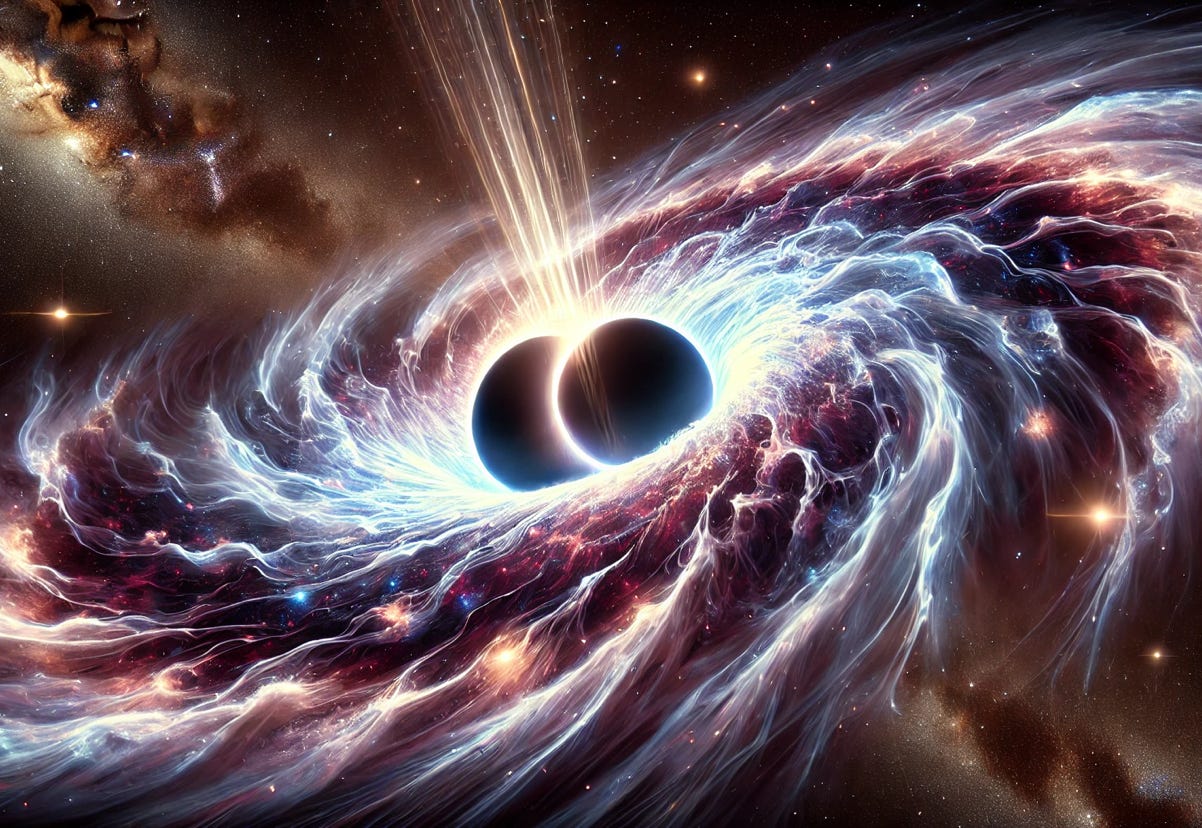
In a new study, researchers propose that a binary supermassive black hole system—two black holes orbiting one another in the heart of the same galaxy—could be shredding a cloud of gas, rather than a single star. The gravitational dance of the black holes in this configuration could lead to repeated episodes of increased brightness, as the displaced gas interacts with the system.


Based on the observed outbursts, the study estimates that the separation between the two black holes is about 0.83 milliparsecs (mpc). On cosmic timescales, this pair would merge in a relatively short period of about 70,000 years, although for humans that is still extraordinarily long.


As if the scenario were not already complex enough, the galaxy hosting AT 2021hdr lies only 9 kiloparsecs from a companion galaxy—a distance that suggests the two galaxies might also merge. This two-galaxy system was reported recently, but the authors emphasize that the companion galaxy is unlikely to be responsible for the eruptive behavior of AT 2021hdr.


If confirmed, the tidal destruction of a gas cloud by a binary black hole would offer a rare opportunity to study the final stages of black hole mergers.

Contact us at:

 iss dash sci at spacescience dot ro