ASPACE-Q
The Astrophysics, Space Exploration and Quantum Computing Group
ASPACE-Q
The Astrophysics, Space Exploration and Quantum Computing Group

by Andrei Militaru
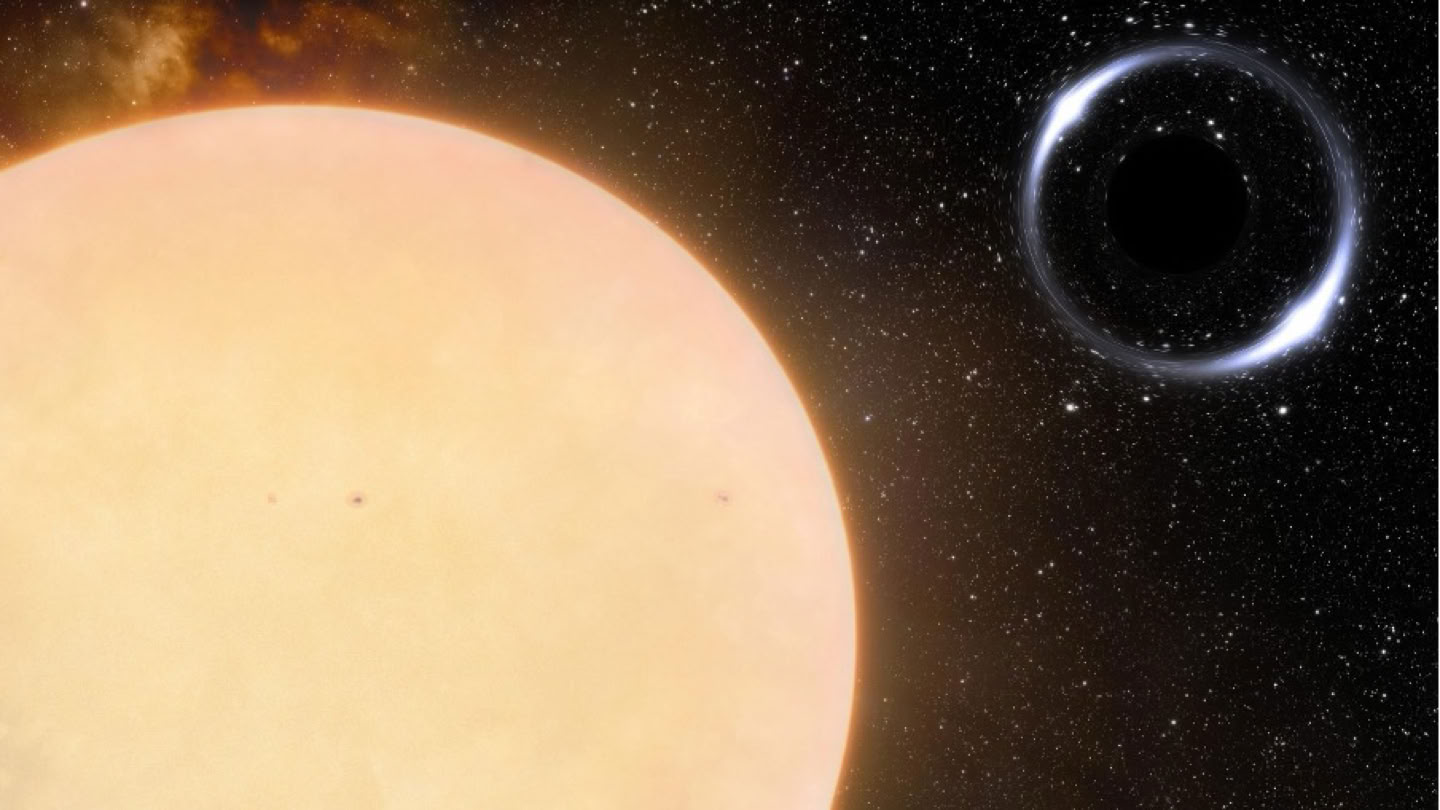
Credit: https://scitechdaily.com/revealed-first-dormant-stellar-mass-black-hole-in-our-cosmic-backyard/
Black holes are usually discovered using the radio and x-ray emission of the surrounding accretion disk, but a new type has been recently discovered thanks to new methods of detection.
Those have being named dormant black holes with luminous companions, and 3 such black holes have been discovered by the mission Gaia: Gaia BH1, BH2 and BH3, with Gaia BH1 being the closest discovered black hole to our Solar system, at a distance of 1560 light years away.
Researchers at Xinjiang University compared 2 evolution models to find which reflects the observations of dormant black hole systems better. The first model starts from an isolated binary star system, while the second starts with a triple star system. Their study concludes that triple star system in which the inner binary stars collapsed into a black hole may be the most common way dormant balck hole systems have been created.
Source: https://arxiv.org/pdf/2512.04774