ASPACE-Q
The Astrophysics, Space Exploration and Quantum Computing Group
ASPACE-Q
The Astrophysics, Space Exploration and Quantum Computing Group

by Maria Ișfan, PhD student
An international group of scientists from IBM, The University of Manchester, Oxford University, ETH Zurich, EPFL and the University of Regensburg obtained a molecule never seen before: C13Cl2.
What makes this molecule special? First is, the way it was synthesized – or, better said, engineered. Such a molecule cannot be found in nature. It was literally assembled in an IBM laboratory, atom by atom, using voltage pulses. Second is what this engineering could achieve: a molecule whose electrons do not move in the way we know from traditional chemistry, but on half-Mobius, or, helicular, orbitals.
How did the scientists confirm the never-before-seen structure and behavior of the molecule? With a quantum computer, because the task would overwhelm a classical one. In order to simulate such a large, complicate and new molecule, it is necessary to simulate the quantum properties and interactions, such as entanglement, that make up the molecule. This is very computationally expensive and delicate to implement. But why struggle if there is already a kind of computer that already operates on quantum spookyness? Quantum computers are the best choice for studying chemical composites, with clear advantages over traditional computers. Of course, the group used an IBM quantum computer and proved the exotic shape of the molecular orbitals, making Feynman’s dream come true. They also found the mechanism behind this shape: a helical pseudo-Jahn-Teller effect, or, in other words, the electrons have very well defined and stable states.
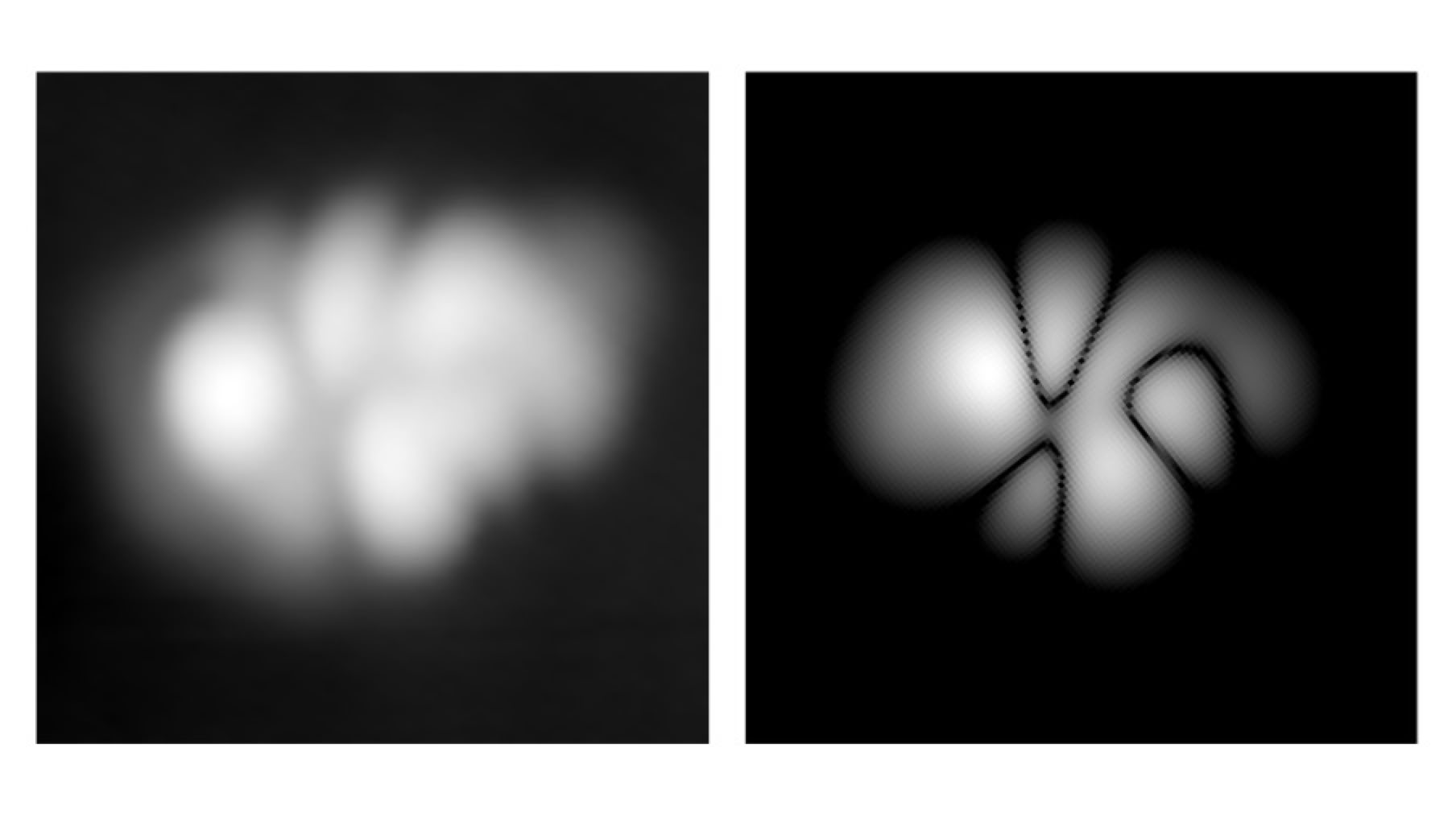
Left, a scanning tunneling microscopy image of the new half-Möbius molecule's electron orbital density; right, a simulated STM image of the molecule's orbital density, which was made using an IBM quantum computer.
Source: Igor Rončević et al. ,A molecule with half-Möbius topology.Science0,eaea3321, DOI:10.1126/science.aea3321