ASPACE-Q
The Astrophysics, Space Exploration and Quantum Computing Group
ASPACE-Q
The Astrophysics, Space Exploration and Quantum Computing Group

by Dr. Alice Mihaela Păun
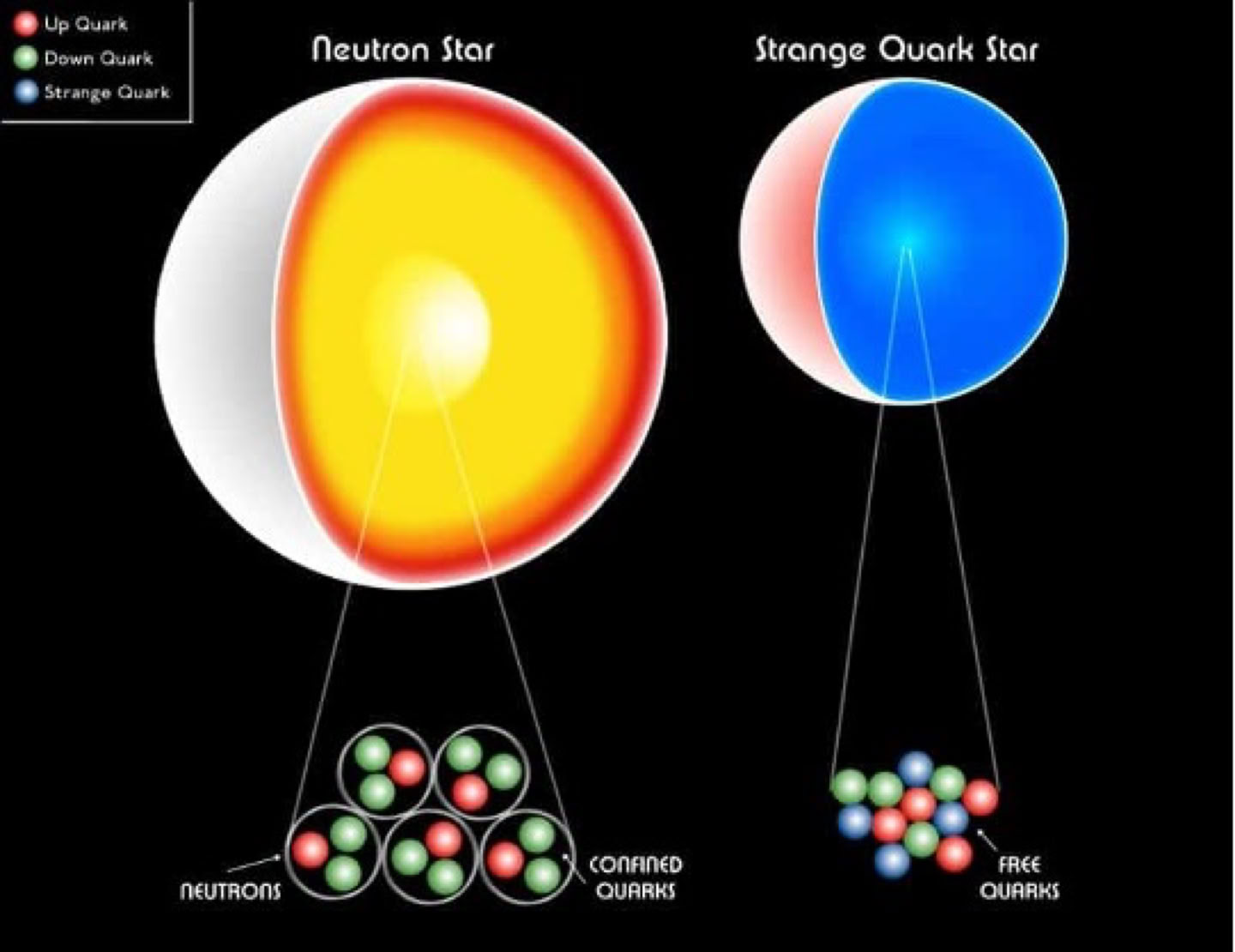
Courtesy: CXC/M Weiss
Dark Matter is the invisible material that makes up about 85% of all matter in the Universe. For a long time, researchers have been trying to provide an answer to this question: What is Dark Matter made of?
A new theoretical proposal is that Dark Matter could actually be something very strange: nuggets of Strange Quark Matter. This is the most extreme form of matter, an extremely dense “soup” made of three types of fundamental particles called quarks (up, down, and strange quarks). According to several theoreticians like Witten, De Rujula, Di Clemente et al., strange quark matter could have been formed shortly after the primordial explosion (Big Bang), a period of time in which the Universe was very young, hot, and chaotic. I the conditions were right, small, very dense aggregates made of this material could have formed and survived as relics up to this date, floating through space as Dark Matter.
An even more interesting fact is that the strange quark matter may be more stable than ordinary matter. If this is true, the consequences would entirely change everything we know about physics. Common matter like iron would not be the ultimate ground state of nature anymore, but instead a tightly packed mixture of up, down, and strange quarks, denser than anything we can create on Earth, would take its place.
Moreover, a study by astrophysicist Fridolin Weber shows that if strange quark matter really is stable, then some neutron stars, already among the densest objects in the cosmos, may actually be something even more extreme: Strange Quark Stars. These exotic stars would be made almost entirely of quark matter and could spin faster, shine differently, and behave in ways unlike ordinary neutron stars. If dark matter is made of strange quark matter, scientists argue that strange quark stars should certainly exist. Over billions of years ago, tiny dark matter “seeds” could collide with dense stellar cores, triggering several transformations inside stars and converting them into quark stars.
The first question that pops into everyone’s mind: why haven’t we seen strange matter yet? The answer is short and elusive: Strange quark matter would be extremely rare and heavy, and mostly…invisible, just like Dark Matter. New generations of neutrino telescopes, gravitational wave detectors, and space telescopes are continuously developing, so scientists may soon be able to test whether the Universe is filled with this exotic form of matter and whether some stars have already crossed the line into the unknown.
References:
1. E. Witten (1984) Cosmic separation of phases. Physical Review D 30, 272-285, https://doi.org/10.1103/PhysRevD.30.272
2. A. De Rujula, S. L. Glashow (1984) Nuclearites – a novel form of cosmic radiation. Letters to Nature 312, 734–737, https://doi.org/10.1038/312734a0
3. Weber, F. (2016). Strange Quark Matter Inside Neutron Stars. In: Alsabti, A., Murdin, P. (eds) Handbook of Supernovae. Springer, Cham. https://doi.org/10.1007/978-3-319-20794-0_71-1
4. Di Clemente, Francesco & Casolino, Marco & Lattanzi, Massimiliano & Ratti, Claudia. (2025). Strange quark matter as dark matter: 40 years later, a reappraisal. Monthly Notices of the Royal Astronomical Society. https://doi.org/10.1093/mnras/staf087