ASPACE-Q
The Astrophysics, Space Exploration and Quantum Computing Group
ASPACE-Q
The Astrophysics, Space Exploration and Quantum Computing Group
by Florentina Pîslan, PhD student
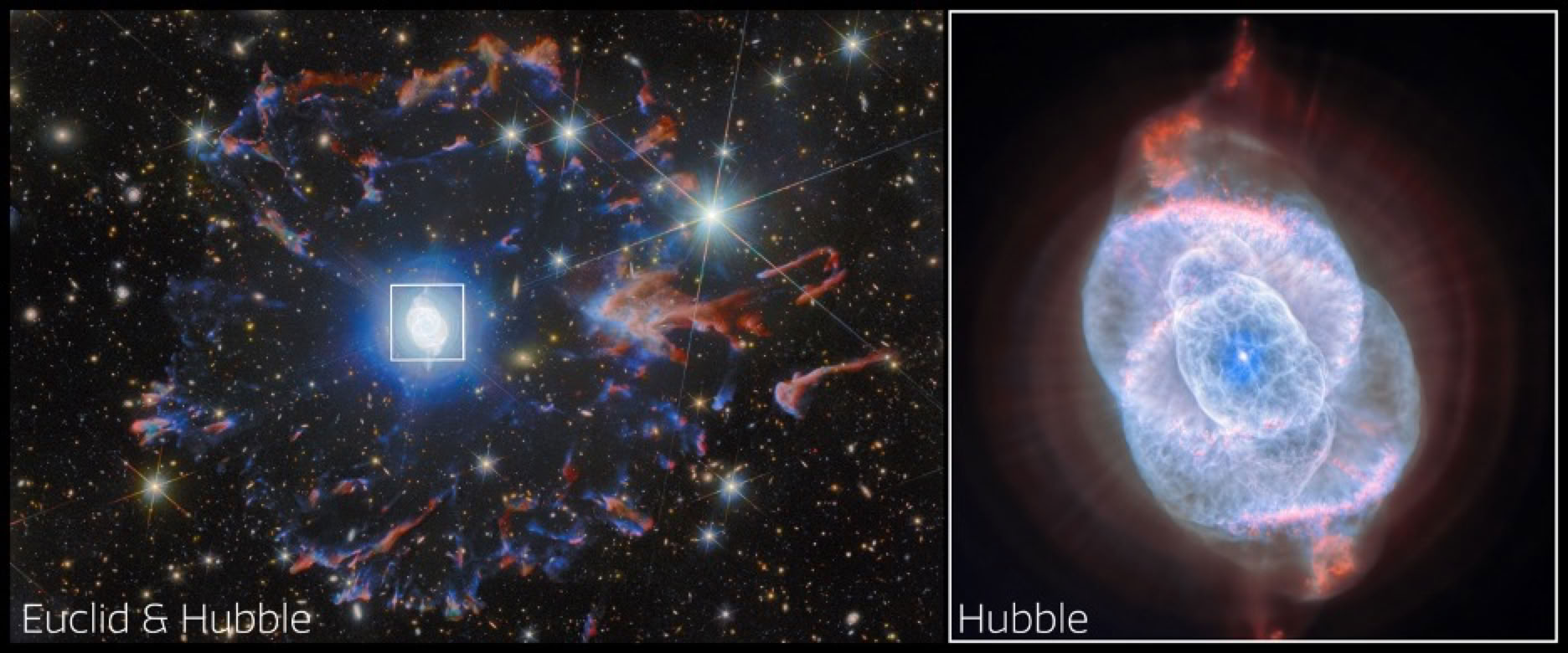
Images of the Cat’s Eye Nebula captured by the Euclid mission and the Hubble Space Telescope.
Credit image: ESA/Hubble & NASA, ESA Euclid/Euclid Consortium/NASA/Q1-2025, J.-C. Cuillandre & E. Bertin (CEA Paris-Saclay), Z. Tsvetanov
One of the most impressive displays of color in the Universe is represented by nebulae. These are large clouds of dust and gas and are part of the life cycle of a star, being either the place where stars are born or the remains of ‘dead’ stars. The multitude of colors comes from the elements they are made of and their temperatures, and these can be captured through telescopes thanks to the different filters used by astronomers, which target specific wavelengths. Most nebulae are diffuse, meaning they do not have clear boundaries, and they can be classified according to their composition and the way they form. Thus, we can encounter: planetary nebulae (they have the appearance of a diffuse planet and form when a star that has reached the Red Giant stage loses its outer layers), emission nebulae (clouds of ionized gas that emit their own light, including in the visible spectrum), reflection nebulae (clouds of dust that reflect light coming from nearby stars), dark nebulae (also known as absorption nebulae; they are very dense dust clouds that block and absorb the light emitted by the stars behind them), and supernova remnants (a bright cloud of matter expelled during a supernova explosion).
A nebula that has attracted the attention of astronomers since 1864 is the Cat’s Eye planetary nebula, also known as NGC 6543. It is located in the constellation Draco, and observations made by the Gaia mission indicate that it lies at a distance of about 4,300 light-years. The most recent images of this nebula come from complementary observations made with the Hubble Space Telescope and the Euclid mission.
Through the ‘Image of the Month’ project, the European Space Agency frequently makes spectacular images of objects in the Universe—captured by the Hubble Space Telescope—available to the public. To stay up to date with them, visit the website https://esahubble.org/images/potm/ .
References:
• https://astromania.org/nebuloase/
• https://www.esa.int/Science_Exploration/Space_Science/Hubble_Euclid_zoom_into_cosmic_eye